Shooting the Silent Cities: How to Photograph Wrecks Without Silt ing the Shot
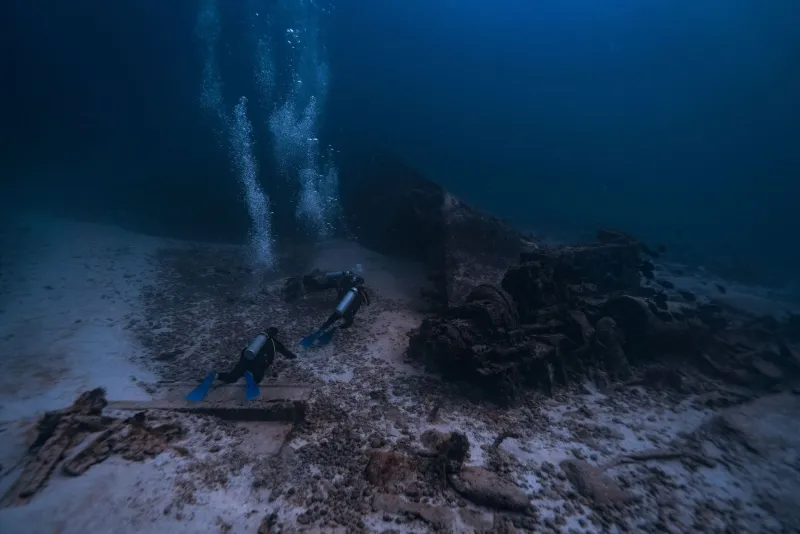
A wreck is the only dive site where you can destroy your own visibility with a single fin stroke. Silt — the fine, disturbed sediment that settles over decades inside a sunken hull — hangs in the water column like smoke and doesn't leave until long after you do. Photograph a wreck carelessly and you'll spend the rest of the dive shooting what looks like milk.
The good news: wrecks reward discipline more than expensive gear. Some of the most photogenic wrecks in American waters — Florida's Spiegel Grove, North Carolina's U-352, the Oriskany off Pensacola — are entirely shootable with one strobe, good positioning, and a plan.
Read the Light Before You Point the Lens
Wreck interiors aren't uniformly dark; they're layered into distinct ambient light zones, and each demands a different approach.
The penetration zone — just inside an opening, where daylight still floods in. This is your money zone. Ambient light can carry the exposure, and the opening itself becomes a compositional frame or a dramatic backlight. Shoot toward the light, expose for the highlights, and let the interior fall into silhouette.
The twilight zone — a few meters deeper in, where ambient light is a dim glow. Here you're blending a strobe or video light with whatever's left. Balance is everything: too much artificial light and you lose the mood that makes wreck photos haunting.
The black zone — beyond any ambient contribution. Honestly? Most photographers should not be here, and most photos from here aren't worth the risk. Overhead environments demand proper wreck penetration training, and no image justifies exceeding your certification.
One Strobe, Positioned Like You Mean It
The instinct inside a wreck is to bring lots of light. Resist it. Multiple strobes on long arms become snag hazards in tight spaces and flatten the texture that makes rust, hull plate, and growth interesting.
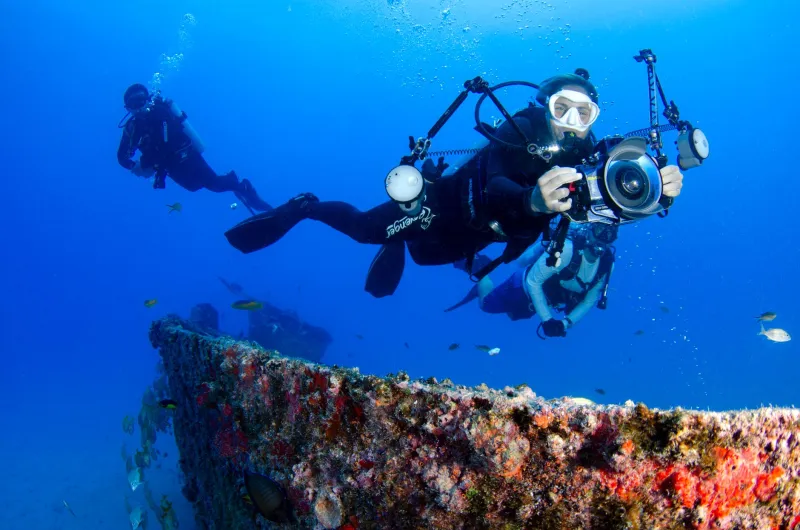
Instead, run a single strobe on a short arm, held off-camera at roughly 45 degrees. This raking angle drags texture across every surface — corroded hull lines, silt-dusted decking, the ribs of a collapsed bulkhead. If your strobe has a modeling-light function or you're carrying a compact video light, use it for focusing and composition, then kill it for the exposure.
Get your strobe off the housing entirely when the space allows. Hand-holding it at arm's length turns a single strobe into a wireless-style setup and lets you paint light around corners and through openings.
Positioning: The Skill That Separates Wreck Photographers From Wreck Tourists
Every rule of trim applies double inside a hull. The divers who come out of wrecks with portfolio shots are the ones who:
- Frog kick or modified flutter exclusively. A standard flutter kick in a wreck is a silt bomb with a timer.
- Stay off the silty deck. Hover a foot or two above the surface. If your buoyancy is shaky, do the interior a favor and shoot the exterior structure first.
- Enter, settle, shoot. The rhythm is: move, stop, become motionless, compose, fire, move. Rushing through a wreck gets you snapshots of nothing and leaves a silt cloud for the diver behind you.
Plan the Dive Around the Photo, Not the Other Way Around
Most wreck dives fail photographically because the schedule defeats them: descend, follow the guide, grab three hasty frames, ascend. You cannot compose in fifteen seconds.
Instead, build photo time into the plan. On a Spiegel Grove dive, know which section you're shooting — the superstructure at 60 to 90 feet, the hull, the crow's nest — and commit to it. Communicate with your buddy: one photographer, one light-tender or safety-focused diver. A buddy holding a video light as a second source doubles your options without doubling your drag.
On deeper wrecks like North Carolina's U-352 in 110 feet of water, bottom time is brutally short. Pre-visualize the shot on the surface, set your exposure and strobe power on the descent line, and drop in already configured. The divers who get the shot are the ones who weren't still adjusting settings when the sand came into view.
The Reward
Done right, wreck photography delivers images nothing else in diving can: geometry, history, and light behaving in ways it never does over an open reef. The wrecks have been sitting there for decades. They'll wait for you to get the kick right.