Gear Won't Save You: What Actually Fixes Underwater Photos (And It's Not the Camera Body)
There's a familiar ritual in underwater photography communities. Someone posts a disappointing shot, gets a handful of polite critiques, and walks away convinced that what they really need is a newer sensor. Maybe a higher megapixel count. Perhaps that full-frame housing they've been eyeing since last winter. Six months and several thousand dollars later, the images look... about the same.
We've all been there, or at least we've watched it happen to someone we dive with. The gear upgrade cycle is one of the most expensive and least effective ways to improve your underwater photography, and it's worth talking honestly about why—and what actually moves the needle.
The Camera Body Is Near the Bottom of the List
Here's something the spec sheets don't advertise: in underwater photography, the camera body is probably the fourth or fifth most important variable in your image quality. Water does things to light that no amount of sensor technology can compensate for after the fact. Backscatter, color absorption, diffusion, and particulate matter are physics problems, not processing problems.
A skilled diver shooting a five-year-old APS-C body with a well-positioned strobe and clean water will consistently outshoot someone with the latest full-frame mirrorless and sloppy technique. That's not a hot take—it's just optics. The medium you're shooting through is the dominant factor, and no firmware update changes seawater.
Positioning Is the Skill Nobody Talks About Enough
Get closer. You've heard it before, but let's be specific about why it matters so much underwater. Every additional foot of water between your dome port and your subject is another foot of light-scattering particles, color shift, and lost contrast. The ocean between you and your subject is actively degrading your image in real time.
But it's not just about physical proximity. It's about angle. Shooting slightly upward toward a subject against open water gives you a cleaner background and avoids the mud-colored reef floor creeping into your frame. Working with the ambient light direction rather than fighting it can mean the difference between a flat, lifeless shot and something with genuine dimension.
Positioning is also about patience, which is harder to quantify but just as important. Hovering neutrally, waiting for a fish to turn toward you, watching how a current will bring a nudibranch into better light—these are skills that compound over time and cost nothing except practice dives.
Your Strobes Are Doing More Damage Than You Think
If there's one area where underwater photographers consistently leave quality on the table, it's strobe placement. Most divers set up their arms once, find a configuration that mostly works, and never revisit it. That's a mistake.
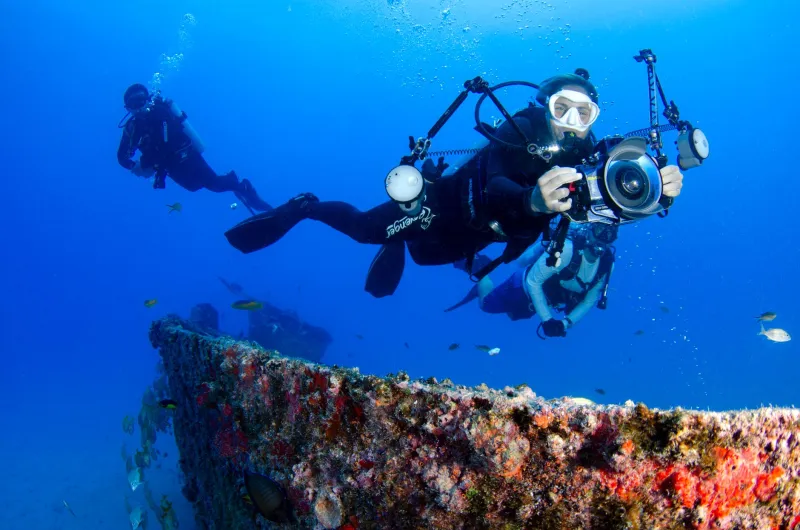
Strobe angle relative to your subject changes everything. Lights that are too close to the port axis throw light directly down the same path as your lens, which is exactly how you manufacture backscatter. Pulling your strobes wide and angling them inward—so the light hits your subject from the sides rather than the front—dramatically reduces the amount of illuminated particles between you and the subject.
Beyond backscatter, think about what the light is actually doing to your subject's texture and color. Flat front lighting flattens everything it touches. Side lighting reveals texture, creates shadows that define shape, and makes marine life look three-dimensional instead of like a sticker on a photograph. Playing with strobe position for an entire dive, without changing a single camera setting, will teach you more than most tutorials.
Reading the Water Is an Underrated Superpower
Not all dives are created equal, and the conditions you're shooting in should fundamentally change your approach. Visibility, thermocline layers, time of day, depth, and even the season all affect what's possible in a given dive.
Shooting in poor visibility and expecting tack-sharp wide-angle shots is a setup for frustration. Shifting to macro in those conditions—where your working distance is inches rather than feet—often produces dramatically better results. Recognizing that a particular dive site rewards patience and stillness over active swimming means you'll come home with more keepers.
American divers hitting popular sites like the Florida Keys, California's Channel Islands, or the Pacific Northwest kelp forests all encounter wildly different optical environments. What works in the warm, clear water off Key Largo is a different playbook than what you need in the cold, green-tinted surge off Monterey. Learning to read and adapt to those conditions is a skill that transfers across every piece of gear you'll ever own.
Post-Processing Workflow: The Step Most Divers Rush
Shooting RAW is the baseline—if you're not doing that already, start there. But having a consistent, intentional post-processing workflow is where a lot of underwater photographers leave significant quality unrealized.
Underwater images almost always need targeted color correction, not just global adjustments. The red and orange channels are typically crushed, especially at depth, and recovering them requires more than dragging a single temperature slider. Learning to use HSL adjustments, selective color correction, and masking in Lightroom or Capture One specifically for underwater work is a genuine skill that takes time to develop.
Sharpening and noise reduction underwater also behave differently than in topside photography. Water introduces a specific kind of diffuse softness that responds better to texture and clarity adjustments than to raw sharpening. Experimenting with those tools deliberately—rather than applying a preset and moving on—will change how your images look.
So When Does a Gear Upgrade Actually Help?
To be fair: there are legitimate reasons to upgrade. If your housing doesn't support the ports you need for the lenses that would serve your shooting style, that's a real constraint. If your current strobe recycles too slowly for the subjects you're chasing, that's worth solving with hardware. If you're shooting video and your current body genuinely can't deliver the dynamic range you need, that's a real gap.
But those are specific, diagnosable problems with specific solutions. "My photos aren't as good as I want them to be" is not a camera body problem. It's almost always a technique problem, a lighting problem, a positioning problem, or a workflow problem—and all of those are fixable without touching your credit card.
The Actual Path Forward
Spend a few dives focusing entirely on strobe positioning. Vary your angles deliberately and review results critically. Take a dedicated macro dive at a site you know well and work on getting genuinely close to subjects. Watch how the ambient light behaves at different times of day and use it intentionally.
Then go home and spend time in post-processing with the images you're least happy with. Understand specifically why they're not working. Is it color? Contrast? Backscatter? Sharpness? Each of those has a root cause, and most of them live in your technique, not your camera.
The divers producing consistently excellent images are, without exception, students of the water. The gear is secondary. It always has been.