What's In Your Tank Is Messing With Your Shots: The Photographer's Guide to Breathing Gas and Cognitive Performance at Depth
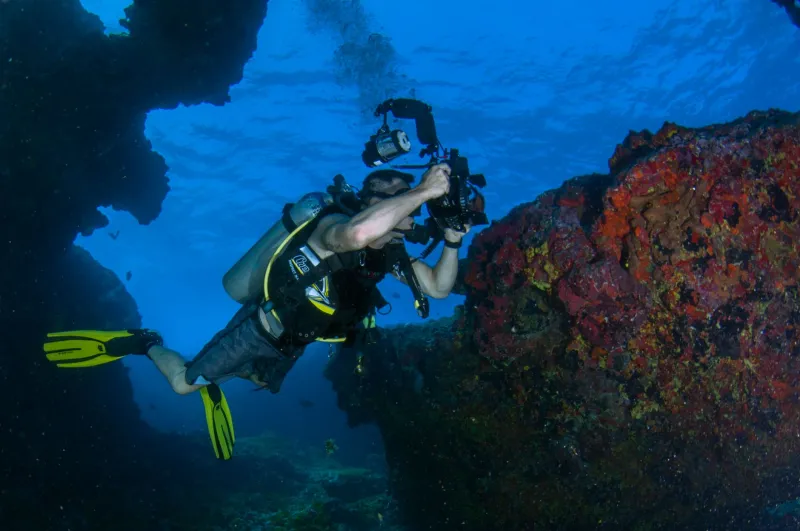
You've calibrated your strobes. You've checked your white balance. You've got a fresh memory card and a housing o-ring that's been cleaned and greased to perfection. You hit the water at 80 feet and... your shots are soft. Your timing is off. You miss the moment by half a second, every single time.
Before you blame your autofocus system or your trigger finger, consider something most underwater photographers never think about: the gas in your tank.
Nitrogen narcosis is a well-documented phenomenon in recreational and technical diving circles, but the photography community tends to treat it as an extreme-sport problem — something that affects cave divers and wreck penetrators, not the recreational shooter hovering over a coral head at 90 feet. That assumption is costing people good images.
Narcosis Doesn't Announce Itself
Here's the uncomfortable part. Nitrogen narcosis doesn't feel like being drunk — at least not in the obvious, stumbling way most people imagine. At moderate depths, the cognitive impairment is subtle. Reaction times slow by fractions of a second. Fine motor control degrades just enough that your thumb misses the shutter release cleanly. Decision-making becomes slightly less efficient, which means you hesitate longer before committing to a composition or adjusting exposure.
For everyday diving, those impairments are manageable. For photography — where timing, precision, and rapid creative decisions are everything — they're significant. A 20% reduction in reaction speed at 85 feet can be the difference between a sharp frame of a passing eagle ray and a blurred tail disappearing out of frame.
The key variable here is nitrogen partial pressure, which increases with depth. The deeper you go, the higher your blood nitrogen levels, and the more pronounced the narcotic effect. But here's what most recreational divers don't realize: you can actually control how much nitrogen you're breathing.
Nitrox Is Not Just a Bottom-Time Tool
Enriched air nitrox — typically sold as EAN32 or EAN36 at US dive shops — is commonly marketed around its extended no-decompression limits. Dive longer, ascend safer. That's the pitch. But there's a secondary benefit that rarely gets mentioned in certification courses: lower nitrogen content means reduced narcotic load at equivalent depths.
If you're diving EAN32 (32% oxygen, 68% nitrogen) instead of standard air (roughly 21% oxygen, 79% nitrogen), you're inhaling noticeably less nitrogen with every breath. At 80 feet, that difference translates to a meaningfully lower partial pressure of nitrogen in your bloodstream. The narcotic effect doesn't disappear, but it's measurably reduced — and for a photographer trying to execute precise, time-sensitive work, that margin matters.
Think of it this way: you wouldn't shoot a fast-moving reef fish at a shutter speed that's technically capable of freezing motion but sitting right at the edge of your camera's limit. You'd give yourself some headroom. Optimizing your gas mix is the same principle applied to your own cognitive hardware.
Practical Mixes for Common US Dive Destinations
The US has incredibly diverse dive environments, and gas availability varies by region. Here's a rough breakdown of how to think about mix selection based on where you're shooting:
Florida (Keys, Springs, Blue Holes): Most dive operations in the Keys offer EAN32 as a standard upgrade, often for $10–$15 per fill. For shallow reef photography in the 40–70 foot range, standard air is generally fine. But if you're pushing into the 80–100 foot zone chasing goliath grouper or deep coral structures, EAN32 is worth every penny. Freshwater spring diving tends to stay shallow, but the clarity and fast-moving subjects make clean motor control especially valuable — EAN32 is a reasonable choice even at 30 feet.
Hawaii (Maui, Kona, Oahu): Hawaiian reef photography often involves depths in the 60–90 foot range, particularly for manta ray encounters at night or cleaning station shots. Many operators on the Big Island and Maui stock nitrox. EAN32 is your friend here. The added bottom time also means more opportunities to wait for the right moment without rushing your ascent — which directly benefits your shooting.
Pacific Northwest (Puget Sound, San Juan Islands): Cold water diving here already stresses your body and burns through mental bandwidth faster than warm-water diving. Narcosis compounds that load. If you're shooting giant Pacific octopus or wolf eels in the 70–100 foot range, EAN32 can help offset some of the cognitive drag. Nitrox availability is improving at Pacific Northwest dive shops, though it's not as universal as in Florida.
Gulf of Mexico (Texas Flower Gardens, Alabama artificial reefs): Depths at the Flower Garden Banks run 60–100+ feet, and nitrox fills are commonly available from live-aboard operators. Given the distance traveled to reach these sites, you want every possible advantage when you're finally in the water — EAN32 is an easy call.
The Photography Workflow Adjustment
Switching to nitrox doesn't require a major overhaul of your dive plan, but it does require one important habit: analyzing your mix before every dive and setting your dive computer's oxygen percentage accordingly. This is non-negotiable — diving nitrox without proper analysis and computer configuration creates real oxygen toxicity risk, particularly at deeper sites.
Beyond safety, consider building a simple pre-dive mental checklist that mirrors how you'd check your camera before entering the water. Confirm your mix. Set your MOD (maximum operating depth) sticker on your tank. Brief your buddy. Then run through your camera settings with the same deliberate attention. Treating your gas mix as part of your photography kit — not just your safety equipment — shifts your mindset in a useful way.
It's also worth noting that hydration plays a supporting role here. Dehydration accelerates narcotic susceptibility and degrades fine motor control independently of nitrogen levels. Divers who show up to their boat already running a water deficit are fighting an uphill battle even on standard air. Hydrate the night before, hydrate the morning of, and skip the coffee until after your first dive if you're sensitive to its diuretic effects.
Beyond Nitrox: When Trimix Enters the Conversation
For photographers regularly working below 100 feet — deep wrecks, wall dives, blue-water pelagic work — trimix becomes a legitimate consideration. By replacing a portion of nitrogen with helium, trimix dramatically reduces narcotic load. Helium doesn't produce the same narcotic effect as nitrogen at equivalent partial pressures.
Trimix certification and gas costs are higher, and availability at US recreational dive shops is limited outside of technical diving communities. But if your photography takes you into the 130–200 foot range on a regular basis, the cognitive clarity it provides is a genuine competitive advantage. Some of the sharpest, most technically demanding underwater images being made today are shot by photographers who treat their gas mix as seriously as their lens choice.
The Bottom Line
Your camera is only as good as the person operating it. And the person operating it is only as sharp as the gas they're breathing. Nitrox certification is inexpensive, widely available across the US, and the incremental cost per fill is trivial compared to what you've already invested in your housing, strobes, and glass.
Next time you're prepping for a dive where depth and image quality both matter, treat your tank fill the same way you treat your camera settings: with intention. The reef doesn't care how much you paid for your rig. But your images will reflect every advantage — or disadvantage — you brought into the water with you.