Hover First, Shoot Second: The Hidden Cost of Dragging a Camera Through a Dive
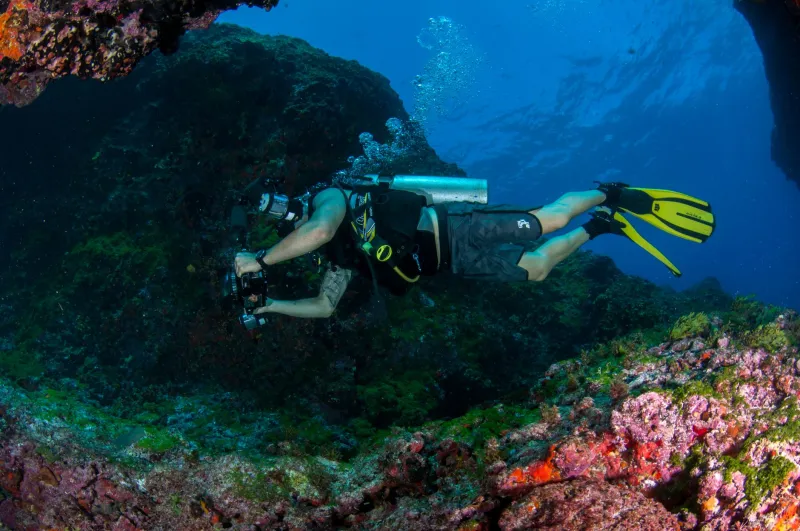
Let's get the uncomfortable part out of the way: the reason your last fifty reef shots are blurry, backscattered, or framed on empty water probably isn't your gear. It's your buoyancy.
We spend a lot of time on this site talking about housings, ports, and strobe triggers — and that stuff matters. But there's a quiet tax levied on every dive where the camera comes along, and most of us pay it without ever noticing. Call it the buoyancy tax. Every time you crash into coral trying to frame a nudibranch, every time you kick up sand a half-second before firing, every time you're fighting to stay off the bottom while your rig drags you nose-down — that's the tax. And it's paid in ruined shots.
The Rig Is Working Against You
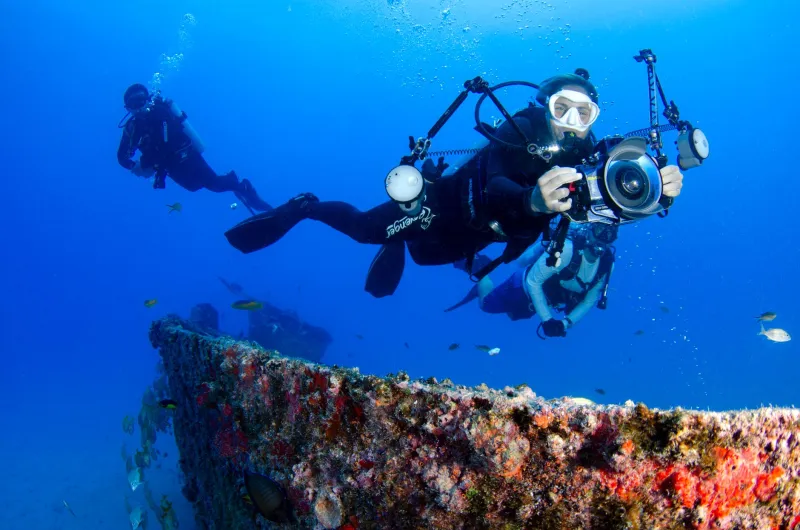
Underwater camera setups are buoyancy saboteurs by design. A mirrorless body in a housing with a dome port and two strobes can weigh eight pounds on the surface and behave completely unpredictably at 40 feet. Add a tray, arms, and a dive light, and you've essentially strapped a small anchor to your chest that shifts its center of gravity every time you reposition.
The result: you add weight to compensate, then add more air to your BCD to offset the weight, then find yourself making constant micro-corrections instead of composing. Meanwhile, your fins are stirring the bottom into milk, and your subject — a decorator crab that waited ten minutes for you — is now invisible in a sand cloud of your own making.
Here's the honest math: a new strobe might improve your light by 20%. Fixing your trim and rig balance can improve your keeper rate by 50% or more. One of those costs $700. The other costs a pool session.
Drills That Actually Transfer to the Reef
If you want to shoot sharp, you need to hover like a helicopter pilot, not flail like a swimmer. These are the drills we recommend to anyone serious about underwater imaging — and yes, they're boring. That's the point.
The Motionless Minute. Descend to a safe sandy area, pick a focal point, and hover without moving your hands, fins, or torso for a full 60 seconds. If you drift, correct with breath control, not your BCD. Most divers fail this on the first three tries. Your camera needs you motionless for about two seconds to nail focus — this drill builds that.
The Compose-and-Hold. Find a static subject like a sponge or anemone. Frame the shot you want, then hold that exact framing for 30 seconds while breathing normally. This mimics the real workflow of underwater photography: find the composition, wait for the subject to behave, fire.
The Finless Frame. In a pool or over sand, hover using only lung volume while your hands simulate holding a housing at eye level. If your rig pulls you forward or tips you, you've just discovered a weight distribution problem before it cost you a dive.
The Backward Retreat. Practice backing away from an object without a single down-kick. Photographers scare more subjects by pushing water forward than by any other mistake. Frog kick and reverse kick are photo skills, not dive skills.
Is Your Rig Worth the Drag? A Quick Framework
Not every setup deserves to come on every dive. Before your next trip, run your rig through this test:
- Can you hold the motionless minute while holding it? If not, it's too big for your current skill level, full stop.
- Does it change your trim? If the rig pulls you into a nose-down or roll-prone attitude, redistribute — move a strobe arm, shift the tray, add a float arm instead of lead.
- What's the ratio of shots you'd actually publish to weight carried? A GoPro in a tray earns its place on every dive. A three-strobe macro rig on a drift dive does not.
- Would you attempt this dive without the camera? If the answer is no — strong current, silty wreck, deep wall — the camera is a liability, not a tool.
Point one deserves emphasis. Buoyancy clinics through agencies like PADI or SSI typically cost between $100 and $200 and take a single day. Compare that to the price of a quality strobe, then ask yourself which purchase your portfolio actually needs.
The Unpopular Conclusion
The dive industry has every incentive to sell you gear, and we review plenty of it. But the single biggest image-quality upgrade available to most underwater photographers isn't in a box. It's in your trim, your breathing, and your willingness to slow down.
Take the clinic. Do the drills. Learn to hang in the water column like you were poured into it. Then go buy the strobe — because at that point, you'll actually be steady enough to use it.