Let There Be (The Right) Light: A No-Fluff Guide to Underwater Strobes and Video Lights
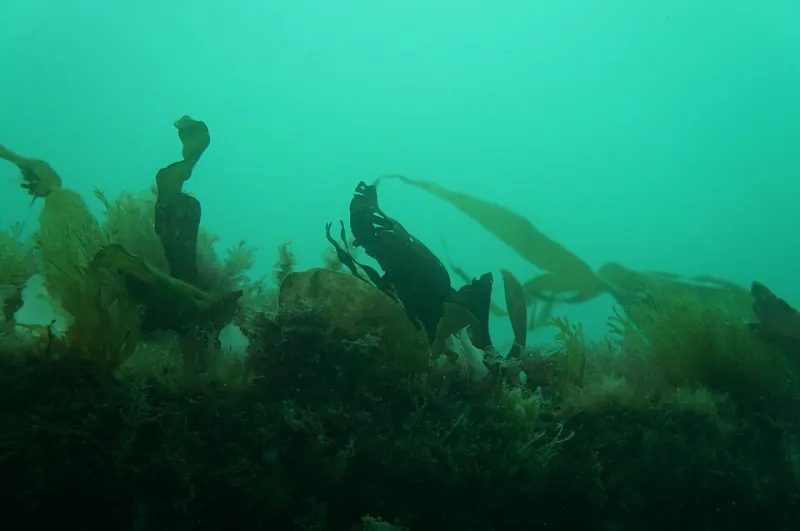
Photo: HannahHawke, CC BY-SA 2.0, via Wikimedia Commons
Here's the uncomfortable truth about underwater photography: your camera is only half the equation. You can drop serious money on a housing, nail your buoyancy, and get within arm's reach of a stunning subject — and still walk away with flat, blue-green images that look like they were shot through a fish tank filter. The missing ingredient is almost always light.
Underwater lighting isn't a luxury upgrade. At anything beyond about 15 feet, red wavelengths have already been absorbed by the water column. By 30 feet, orange is largely gone too. What's left is a progressively narrower slice of the spectrum — mostly blue and green — that no white balance setting can fully compensate for. The only real fix is introducing your own light source close to the subject. The question is which one, at what price point, and for what kind of shooting.
Let's break it down.
Understanding What You're Actually Buying
Before comparing products, it helps to understand the specs that actually matter — because manufacturers love to lead with numbers that sound impressive but don't tell the whole story.
Lumen output tells you how much total light a unit produces. But lumens alone don't tell you how that light is distributed. A 5,000-lumen light with a narrow 60-degree beam creates a bright hot spot in the center and falls off dramatically at the edges. A 5,000-lumen light with a 120-degree beam covers more area but appears less intense at any given point.
Color temperature is expressed in Kelvin. Daylight sits around 5,500–6,500K. Most quality underwater video lights and strobes aim for 5,500–6,000K because that's what renders natural colors most accurately when you're adding artificial light to a blue-shifted environment. Cheaper lights often drift toward 4,000K or lower, which adds a warm/yellow cast that's flattering for portraits but unflattering for coral and marine life.
Color Rendering Index (CRI) measures how accurately a light source renders colors compared to natural sunlight, on a scale of 0–100. For underwater work, you want CRI 90 or above. Budget lights frequently cut corners here — their marketing lumen numbers look great, but the colors they render look muddy or oversaturated in ways that are difficult to correct in post.
Guide number applies specifically to strobes and represents the relationship between aperture, distance, and power output. It's less critical for casual shooters but useful when you're trying to calculate exposure for specific subject distances.
Budget Tier: GoPro-Compatible LED Panels and Entry-Level Video Lights ($50–$200)
If you're shooting with an action cam or a basic point-and-shoot housing, this is your world. Products like the Kraken Sports KRL-01 or the Bigblue AL1200NP represent the entry point — compact, lightweight, and genuinely useful for shallow reef shooting in the 20–40 foot range.
The honest assessment: these lights work well for what they are. At shallow depths where some natural light still exists, even a modest 800–1,200 lumen panel makes a visible difference in color rendition and subject detail. The limitations show up fast in deeper water or low-visibility conditions, where the output isn't strong enough to meaningfully cut through backscatter and ambient blue light simultaneously.
For GoPro users specifically, a dual-light setup — two small panels mounted on either side of the camera on a tray — is dramatically more effective than a single central light. The symmetrical placement reduces backscatter (the underwater photographer's nemesis, caused by particles reflecting light directly back into the lens) and creates more even illumination across the frame.
Expected battery life at full power in this tier: 45–90 minutes. Fine for a single dive, but bring a spare for a two-tank day.
Mid-Range: Where Most Serious Hobby Shooters Should Live ($200–$600)
This is the most interesting segment of the market right now, because the gap between mid-range and high-end has narrowed considerably over the past few years. Lights like the Kraken Hydra 2500 WSR, the Backscatter Mini Flash, and the Keldan Ambient 4 offer genuinely professional-grade color quality at prices that don't require a second mortgage.
For video shooters, the Backscatter Mini Flash + Optical Snoot combo deserves a specific callout. The snoot attachment allows precise, directional lighting for macro subjects — it's the underwater equivalent of a beauty dish — and the ability to control beam width transforms what's possible compositionally. This kind of creative control used to require investing in a full professional strobe system.
For still photographers at this price point, the Sea & Sea YS-03 Solis strobe offers reliable TTL (through-the-lens) metering compatibility with most major mirrorless systems, a respectable guide number, and a wide enough beam angle (110 degrees) to handle wide-angle work without vignetting. TTL matters more than many experienced shooters admit — when you're tracking a moving fish or reacting quickly to an unexpected subject, not having to manually adjust strobe power between shots is a genuine workflow advantage.
At this tier, beam angle becomes a real consideration based on your shooting style. Macro photographers generally prefer narrower beams (60–90 degrees) for control and subject isolation. Wide-angle and reef photographers need broader coverage (100–120+ degrees) to illuminate larger scenes evenly.
High-End: Professional Strobe Systems ($600–$2,000+)
If you're shooting for publication, running a dive photography business, or just refuse to compromise, the Ikelite DS161, Inon Z-330, and Sea & Sea YS-D3 Lightning are the benchmarks the industry measures everything else against.
What separates these from the mid-range tier isn't just raw power — it's consistency and control. Professional strobes recycle faster (critical when shooting burst sequences of fast-moving pelagics), offer finer power adjustment increments, and maintain color accuracy across their full power range. Cheaper strobes often shift color temperature as power increases, which creates subtle inconsistencies in a sequence of images that are maddening to correct in Lightroom.
For video at this level, the Keldan Luna 8 CRI and the Light & Motion SOLA Video 4000 are worth the investment for anyone shooting 4K footage intended for broadcast or film. The SOLA series in particular has become a go-to for professional underwater cinematographers for its flat, even output and precise dimming control.
One honest note on high-end strobes: the jump from mid-range to professional tier is more about workflow and reliability than visible image quality in typical conditions. If you're a recreational diver who shoots 40 dives a year, a mid-range strobe will produce images you'll be proud of. The professional tier pays off when you're shooting 200+ dives a year and need gear that doesn't introduce variables.
Depth, Conditions, and the Backscatter Problem
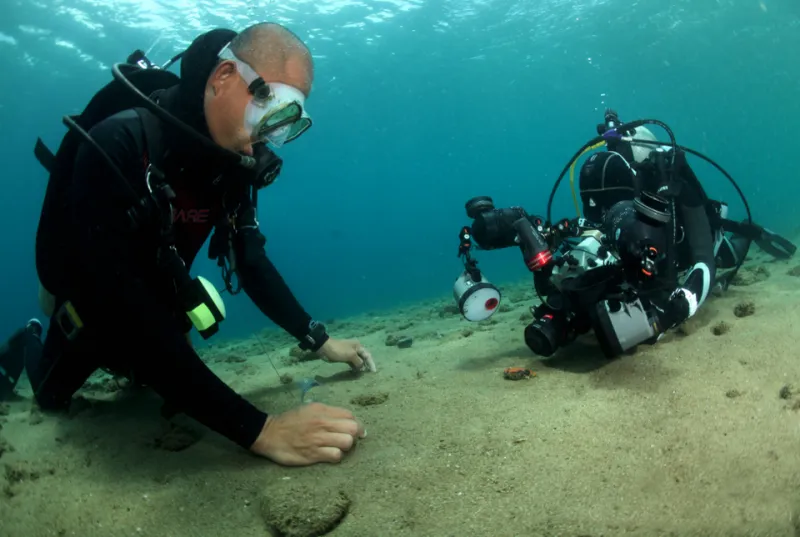
Regardless of budget tier, positioning matters as much as output. Strobes and video lights mounted directly on top of the camera — the way you'd use an on-camera flash on land — are almost guaranteed to produce heavy backscatter in anything other than crystal-clear water. The light fires forward, illuminates every suspended particle between the lens and the subject, and the result looks like you shot through a snow globe.
The fix is arm length and angle. Extend your lights out and away from the camera body on articulating arms, angled inward toward the subject at roughly 45 degrees. This positioning fires the light from the side, so backscatter particles are illuminated away from the camera's line of sight. It's the single most impactful technique adjustment most new underwater photographers can make, regardless of what lights they're using.
In deeper water (below 60 feet), beam angle becomes increasingly important. You're working with less ambient light, which means the contrast between your illuminated subject and the dark background increases. A too-narrow beam creates an obvious spotlight effect. A too-wide beam spreads power thin. Matching your beam angle to your typical subject size and working distance takes some experimentation — and that's part of what makes underwater lighting genuinely interesting to master.
The right light doesn't just illuminate your subject. It reveals it.