Deep Pockets, Shallow Thinking: How Narcosis Turns Your Gear Budget Against You
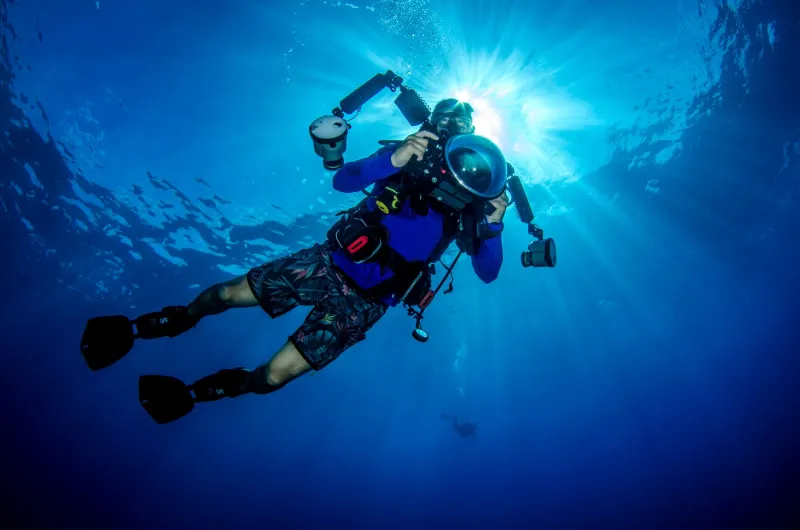
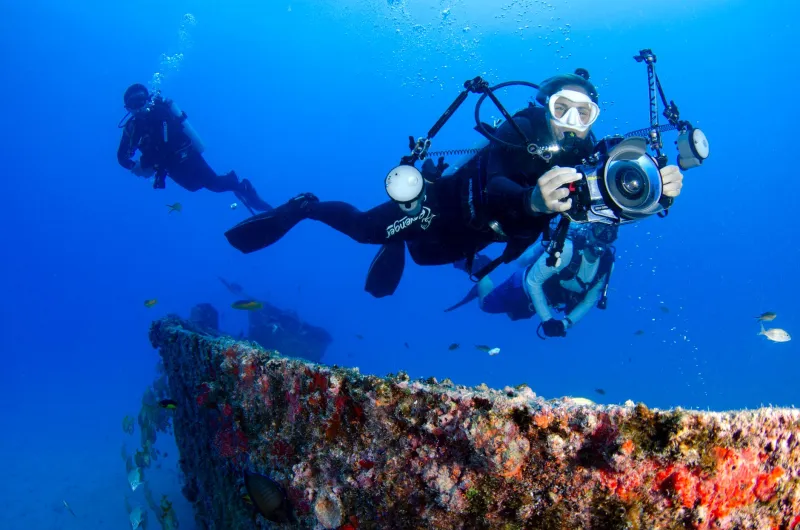
Here's a scenario that plays out more often than most underwater photographers want to admit. You're 90 feet down on a wall dive off Cozumel. The visibility is stunning. You've got a $3,000 mirrorless system in a housing that cost nearly as much, paired with dual strobes you spent three months researching. And you're fumbling with the aperture dial like it's your first time holding a camera.
That's not inexperience. That's nitrogen narcosis—and it's been quietly taxing your photography long before you splashed.
What Narcosis Actually Does to a Photographer's Brain
Nitrogen narcosis is often described with the old "martini rule"—roughly one martini's worth of impairment for every 50 feet of depth. It's a useful shorthand, but it undersells the specific ways it wrecks camera work. You're not just a little foggy. Your ability to sequence tasks, remember multi-step processes, and make quick judgment calls degrades in ways that are hard to notice because narcosis also dulls your awareness of the impairment itself.
For underwater photographers, that's a compounding disaster. You're already managing buoyancy, air consumption, dive computer alerts, and marine life positioning—all while trying to make creative decisions about light, composition, and exposure. Add a meaningful cognitive tax on top of that, and the system overloads fast.
The part nobody talks about? A lot of the gear people buy for deep dives is specifically designed to offer more control, more options, and more complexity. That's exactly what narcosis takes away from you.
The Overbuying Problem Starts at the Surface
When divers research camera systems for serious work below 60 feet, they tend to gravitate toward flagship gear. Full-frame sensors. Wide aperture prime lenses. Housings with dedicated controls for every conceivable function. The logic seems sound: if I'm going to invest in this, I want the best.
But here's the problem with that logic. The "best" gear for deep technical photography is often the gear with the most nuanced control set—and nuanced control is exactly what narcosis strips from you. You end up paying a premium for capabilities you literally cannot access once you're in the depth range where you planned to use them.
One common real-world example: photographers who invest in high-end strobes with adjustable beam angles and multi-channel TTL modes. On a shallow reef at 30 feet, you might actually cycle through those modes and find the right one for a tricky composition. At 100 feet, with narcosis biting, you're going to leave it on whatever setting it was on when you entered the water. Every time. That $800 strobe is now performing like a $200 strobe with extra weight.
The Settings You Actually Use Down There
Talk to experienced deep-water photographers honestly and a pattern emerges. Most of them pre-set everything before the dive and barely touch controls once they're below 70 feet. Aperture gets locked. ISO gets capped. White balance gets fixed to a custom preset or simply left on auto. Strobe power gets dialed to a starting point that works for the expected subject distance, and adjustments are kept minimal.
That's not laziness. That's an adaptation to the cognitive environment. The photographers who try to work the camera the same way at depth as they do on shallow dives are the ones who come back with the most unusable footage.
What this means practically: the gear that performs best in a narcosis-affected state is gear that's simple to operate with gloves, has clearly differentiated tactile controls, and doesn't require navigating menus to do basic things. Ironically, some older or mid-tier systems actually win here—not because they're technically superior, but because their interfaces are less complex.
A Framework for Buying Smarter (Before Depth Clouds Your Judgment)
If you're shopping for a deep-water rig, here's a more honest way to evaluate gear.
Test the controls with compromised dexterity. Put on your thickest dive gloves and try to adjust every key setting without looking at the housing. If you can't change aperture, toggle strobe power, or switch shooting modes by feel alone, that's a liability at depth.
Count the decisions the system requires. Every camera mode, every strobe channel, every custom button you've programmed is a decision point. At depth, you want fewer decision points, not more. If a housing has 14 dedicated controls and you realistically only need 5 of them at 100 feet, you've bought complexity you'll never use and might accidentally trigger.
Simulate a narcosis workload before you buy. This sounds strange, but it's effective. Have a friend ask you rapid-fire trivia questions while you try to adjust camera settings in your target housing. It's a rough analog for divided attention under narcosis. Systems that fall apart under that test will fall apart at depth.
Set a "depth ceiling" for feature value. When evaluating a premium feature—say, a 120fps slow-motion mode or a complex multi-zone metering system—ask yourself honestly: at what depth will I actually use this? If the answer is "only above 50 feet," and you're buying the camera for deep reef work, that feature shouldn't factor into your purchase decision at all.
The Gear That Holds Up When You Don't
Systems that tend to earn praise from experienced deep-water shooters share a few traits. Physical controls that are large, well-spaced, and distinct from each other. Housings that keep essential functions on the outside without requiring menu access. Strobe systems with simple, repeatable power increments rather than granular multi-mode interfaces.
The Sony RX100 series in a compact housing gets more credit than it probably deserves in spec sheets, but it earns real respect from divers who shoot deep regularly—because the interface is streamlined enough to operate under impairment. Same with certain Olympus TG-series setups. Not the flashiest gear, but forgiving in ways that matter when your brain is working at 70 percent.
That's not an argument against investing in quality. It's an argument for defining quality differently when depth is part of your regular dive profile.
Spend Less on Features, More on Fit
The narcosis tax is real, and it applies to every dollar you spend on capabilities you can't access below 80 feet. Before your next gear purchase, be honest about where you actually dive, how deep you regularly go, and what you can genuinely execute down there.
The ocean doesn't care what your housing cost. Narcosis definitely doesn't. Buy for the diver you are at depth, not the photographer you are on the surface—and your shots will show the difference.