Cold Water Is Eating Your Battery Alive — Here's the Physics (And the Fix)
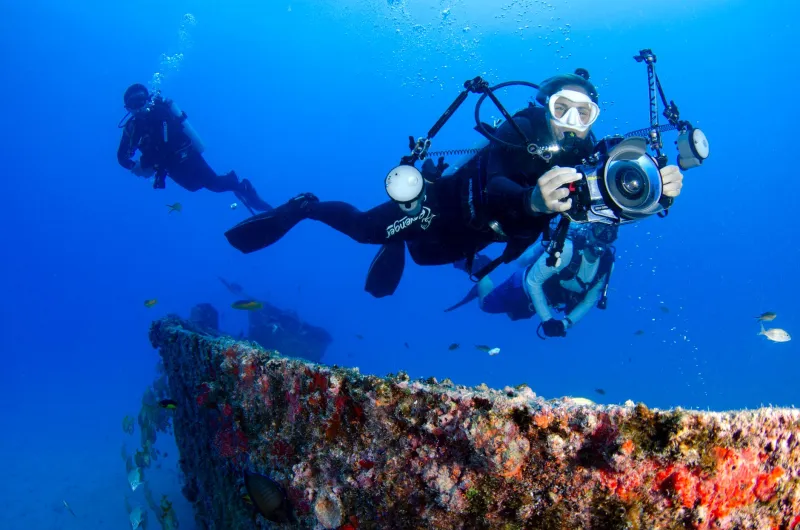
You're 50 feet down off the coast of Monterey, a giant Pacific octopus just settled into the perfect position, and your camera dies. Not low battery — dead. You checked before the dive. You charged it last night. And yet, here you are, watching a once-in-a-season shot disappear into a rock crevice while you hold a very expensive paperweight.
This isn't bad luck. It's chemistry.
Cold water battery drain is one of the most misunderstood problems in underwater photography, and the solutions most people reach for — buying a "higher capacity" battery, charging more frequently, or just accepting it as a fact of life — mostly miss the point. Let's get into what's actually happening and what you can do about it.
Why Cold Kills Batteries Faster Than You Think
Modern camera batteries — almost universally lithium-ion — work by moving lithium ions between two electrodes through an electrolyte solution. That movement generates current. Here's the part the marketing specs never mention: that electrolyte becomes more viscous as temperatures drop. Think of it like cold honey versus warm honey. The ions literally slow down, internal resistance increases, and the battery can't deliver current as efficiently.
At surface temperature, your battery might read 85% and perform exactly as expected. Drop into 48°F Pacific water, and that same battery can behave as if it's at 50% — or lower. The charge didn't disappear. The battery just can't access it efficiently under those thermal conditions.
There's a second hit, too. Your camera housing itself conducts cold inward. Metal housings — aluminum and titanium builds — are particularly efficient at transferring temperature from the surrounding water to the internal components, including the battery compartment. Even polycarbonate housings offer only modest insulation. So even if you pre-warmed your battery before the dive, that advantage evaporates faster than you'd expect.
The "Full Charge" Trap
Here's a mistake that's probably burned you before: charging your battery to 100% the night before a cold-water dive and assuming you're good. You're not — or at least, not as good as you think.
Lithium-ion cells charged to maximum capacity actually handle cold stress worse than cells charged to around 80%. This isn't just theory — it's why manufacturers like Sony and Panasonic include storage charge recommendations. A fully topped-off cell has less chemical buffer to manage the increased internal resistance from cold. The voltage drops faster and more dramatically under load.
For cold-water diving specifically, there's a reasonable argument for charging to 80–85% rather than 100%, then relying on a spare battery for backup. You lose a little theoretical capacity but gain more predictable performance in the conditions that matter.
What Actually Works: Practical Strategies That Hold Up
Keep Batteries Warm Before the Dive
This sounds obvious, but execution matters. Stashing your spare battery in a chest pocket or inside a wetsuit pocket during the surface interval genuinely makes a difference. Your body heat keeps the chemistry active. Some photographers in colder regions — Pacific Northwest, New England, the Great Lakes — tuck hand warmers into their gear bag around spare batteries during the boat ride out. Chemical hand warmers typically hit 130–140°F, which is too hot for direct contact, but wrapped in a cloth or neoprene sleeve next to a battery, they maintain a comfortable operating temperature without risk.
Don't put a warm battery into your housing and then wait 20 minutes on the surface. Get it in and get in the water.
Minimize Power-Hungry Features
Every feature your camera runs continuously is drawing from that cold-stressed battery. Image stabilization, continuous autofocus tracking, LCD brightness, and live histogram displays all pull power. In cold water, the cost of running these features is effectively higher than the spec sheet suggests because the battery is delivering current less efficiently.
For a dedicated cold-water dive, consider: dropping LCD brightness, disabling in-body stabilization if you're using a tray and handles anyway, and switching autofocus to single-shot mode rather than continuous tracking. These aren't permanent sacrifices — they're tactical adjustments for conditions where every milliamp-hour counts.
Carry More Batteries Than You Think You Need
If you're diving in water below 55°F, the general rule of thumb is to assume your battery will deliver roughly 60–70% of its rated shot count or runtime. Plan accordingly. If you'd normally bring one spare for a tropical dive, bring two for a cold-water session. The math just works out differently.
Modular housing systems — Sea & Sea, Nauticam, Ikelite — often make battery swaps between dives fast enough to be practical. Know your system and practice the swap on the surface so you're not fumbling with cold hands.
Consider Housing Configuration
This one gets overlooked almost entirely: the physical layout of your housing affects how quickly cold reaches your battery. If your housing has space for a small neoprene insert or foam padding around the battery compartment, it's worth experimenting with. Some serious cold-water shooters in Alaska and the Pacific Northwest use thin closed-cell foam wrapped around battery sections inside the housing. It's not a dramatic fix, but marginal gains matter when you're already fighting the physics.
Also worth noting: metal port extensions and large dome ports act as thermal bridges, pulling cold into the housing faster than flat ports or smaller glass elements. If you're shooting in cold water and have flexibility in your lens choice, a compact flat port setup runs slightly warmer internally than a full dome rig.
When to Just Accept the Limits
There's a point where optimization stops and physics wins. In water below 40°F — which you'll encounter ice diving in Michigan or Minnesota, or certain North Atlantic conditions — no amount of pre-warming or feature-disabling fully compensates for what cold does to lithium chemistry. In those environments, the real answer is shorter dives, more frequent battery swaps at the surface, and accepting that your system will perform below its rated specifications.
Some photographers shooting in extreme cold have experimented with external battery packs connected through housing ports, essentially keeping the battery mass outside the coldest part of the water column. It's niche, it's complicated, and it introduces leak risk — but it exists as an option for dedicated cold-water work.
The Takeaway
Your battery isn't defective. Cold water is doing exactly what physics says it should do, and your camera is caught in the middle. The photographers who consistently get the shot in cold conditions aren't using magic batteries — they're managing temperature, minimizing unnecessary power draw, and carrying more backup capacity than the spec sheet says they need.
Dive smarter than the conditions. Your shots will show it.