Action Cam or Dedicated Diver? How to Pick the Right Camera Before You Hit the Water
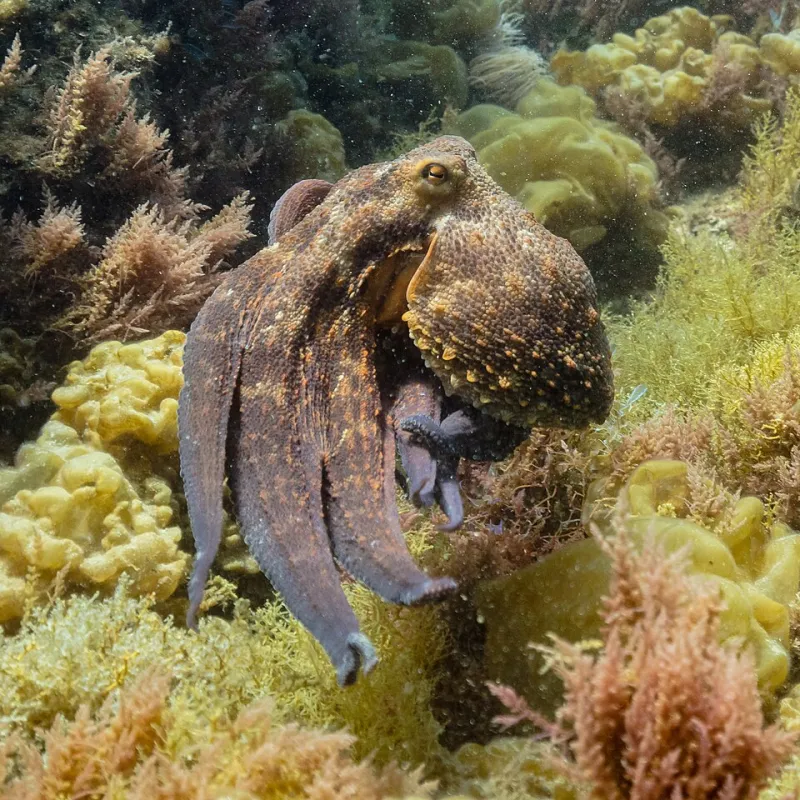
Photo: Tim Sheerman-Chase, CC BY 4.0, via Wikimedia Commons
The Camera Debate That Plays Out on Every Dive Boat
Walk down any dock in Key Largo, Monterey, or Kona and you'll spot at least a dozen GoPros strapped to selfie sticks, wrist mounts, and dive masks. They're small, they're tough, and most divers already own one. But spend five minutes talking to a serious underwater photographer and you'll hear a different story — one that usually involves a dedicated housing, a mirrorless body, and a lens choice that cost more than the plane ticket.
So who's right? Honestly, both sides have a point. The answer depends on what you're actually trying to accomplish underwater, and how much you care about the results once you're back on the surface.
Let's break it down properly.
What GoPro Gets Right (And It's More Than You Think)
The GoPro Hero 13 Black is genuinely impressive for an action camera. It shoots 5.3K video, handles hypersmooth stabilization that would've required a gimbal just a few years ago, and the latest models are rated to 33 feet without a housing — which covers a surprising number of recreational dives. Toss it in an optional dive housing and you're looking at depths down to around 196 feet, which is well beyond most recreational limits anyway.
For divers who are primarily interested in capturing the experience — reef fish, sea turtles, a fun drift dive with friends — a GoPro does a solid job. The wide-angle lens is forgiving in tight spaces, the form factor is compact enough that it doesn't interfere with buoyancy control, and the price point (roughly $399 for the Hero 13 Black) makes it an easy entry point.
If you're shooting video and don't need to pixel-peep every frame, a GoPro is a legitimate choice. Full stop.
Where Action Cameras Start to Struggle
Here's where things get more complicated. Underwater photography isn't just about capturing motion — it's about capturing color, detail, and light in one of the most challenging optical environments on Earth.
Action cameras use small sensors. The GoPro Hero 13 has a 1/1.9-inch sensor, which is decent for its class but significantly smaller than what you'll find in a dedicated compact like the Olympus Tough TG-7 or a mirrorless camera in a housing. Smaller sensors mean more noise in low-light situations, which is exactly what you encounter as you descend past 30 or 40 feet.
Color is another real issue. Water absorbs red wavelengths first, then orange, then yellow as you go deeper. GoPro's auto white balance struggles to compensate for this, and without shooting in a RAW-capable format, your post-processing options are limited. You'll get that flat, blue-green look that screams "tourist footage" rather than "dive photographer."
Manual controls are also minimal. You can adjust exposure compensation and choose from a handful of color profiles, but you can't dial in specific white balance values or adjust aperture — because there isn't one to adjust.
The Case for Dedicated Underwater Cameras
This is where cameras like the Nikon Z30 in an Ikelite housing or the Canon PowerShot G7 X Mark III in a dedicated underwater case start to make a compelling argument.
The Nikon Z30, for example, uses an APS-C sensor that's roughly four times larger than the GoPro's. That translates to better dynamic range, cleaner shadows, and dramatically improved low-light performance. Pair it with a wide-angle wet lens and a set of video lights, and the footage you pull from 60 feet of water looks like it belongs in a nature documentary.
The Canon PowerShot series, particularly the G7 X Mark III, offers a different appeal — it's compact, shoots RAW stills, and gives you manual control over aperture, shutter speed, and ISO. For photographers who want to nail that macro shot of a nudibranch or capture the texture of a coral formation, that level of control is invaluable.
Then there's the color correction advantage. Cameras that shoot RAW give you far more latitude in post-processing. Combined with a red filter for ambient-light shooting in the 15-to-40-foot range, you can achieve accurate, vivid color that a GoPro simply can't match.
Depth Ratings, Housings, and the Real Cost of Going Dedicated
Here's where the math gets a little uncomfortable. A GoPro Hero 13 Black runs about $399. An Olympus Tough TG-7 — a compact camera purpose-built for underwater use — is around $449 and is waterproof to 50 feet without any housing at all. It shoots RAW, has a built-in microscope mode for macro work, and handles color far better than any action camera.
But if you're looking at a mirrorless setup like the Nikon Z30 with a quality housing, strobe arms, and a wide-angle port, you're realistically looking at $1,500 to $3,000 or more depending on how deep the rabbit hole goes. That's a meaningful investment, and it only makes sense if underwater photography is a genuine passion rather than a vacation hobby.
The middle ground — compact cameras like the TG-7 or the Canon G7 X Mark III — sits in a sweet spot around $400 to $700 all-in and offers a real step up in image quality without requiring a second mortgage.
Real-World Performance: Who Should Buy What
Let's be direct about who each option actually serves.
Go GoPro if: You're a recreational diver who wants to capture memories, you prioritize video over stills, you dive in well-lit shallow water, and you want something durable that you won't stress about.
Go compact dedicated (TG-7, G7 X Mark III) if: You want noticeably better image quality without a complex rig, you shoot a mix of stills and video, and you're willing to spend a little more for a meaningful upgrade.
Go mirrorless in a housing if: Underwater photography is a serious pursuit, you're comfortable with camera systems generally, and you're ready to invest in lights, ports, and the learning curve that comes with a full system.
The Honest Bottom Line
No camera is universally right for every diver. A GoPro is genuinely good at what it does, and dismissing it entirely is snobbish and impractical. But if you've ever looked at your underwater footage and felt like it didn't capture what you actually saw down there, that's your signal that it might be time to level up.
The ocean is extraordinary. The gear you choose should do it justice — whatever that means for your budget, your skill level, and the kind of diver you want to become.